

LITHOS project's focus:
EU domestic processing & refining of Li
by expanding and tailoring the existing flowsheet, which was developed for regular-grade spodumene ores, so that
- the cut-off grade for spodumene ores is reduced, resulting in larger Li reserves, while
- allowing the commercialisation of lower-grade pegmatite and RMG deposits.
LITHOS triggers innovations along the value chain – mineral processing, concentrate pre-treatment & hydrometallurgical refining – making it possible to deal with different levels and types of impurities in non-spodumene Li minerals (lepidolite & petalite).
LITHOS' meta-objective:
to unleash Europe’s full Li-hard-rock ore potential so as to become self-sufficient by 2030–35 in terms of made-in-Europe LiOH·H2O.
Furthermore, LITHOS has a responsible mining and refining approach by giving specific attention to closing the water loops in the mineral processing and by reducing the overall CO2 emissions
Li2O
unleashed potential
less
water consumption
Less
CO2 emissions *
* compared to today’s benchmark (production of spodumene concentrate in Australia & refining in China).
LITHOS Consortium

VTT
Coordinator

Finnish Minerals Group
Beneficiary

KU Leuven
Beneficiary

BRGM
Beneficiary

Metso:Outotec
Beneficiary

Keliber
Beneficiry

TUC
Beneficiary

Savannah
Beneficiary

Imerys
Beneficiary

Metso:Outotec
Associated Partner
News

Assessment of mineralogical and chemical quantification of spodumene ore (Li) using a rapid compact XRF–XRD analyzer on-site: Impact of sample preparation on analytical results
A new LITHOS publication in Minerals Engineering, by Metso and BRGM, entitled “Assessment of mineralogical and chemical quantification of spodumene ore (Li) using a rapid compact XRF–XRD analyzer on-site: Impact

Supported by LITHOS: 2nd International Circular Hydrometallurgy Symposium was a huge success!
A resounding success! Almost 200 participants from all over the world.. Nearly half of the attendees came from industry (incl. many seniors), creating a unique environment for knowledge exchange between

LITHOS latest publication in Environmental, Science & Health
We are pleased to announce the publication of our new research article in Environmental, Science & Health entitled “Advances in Cost-Effective, Sustainable and Responsible Extraction of Critical Metals from Hard-Rock Lithium

Press Release: New podcast launched on the global geopolitics of CRMs
SUMMARY The KU Leuven Institute of Sustainable Metals and Minerals (SIM² KU Leuven) has launched a new podcast, “RAW MATTERS”, about the global critical metals and minerals that determine our

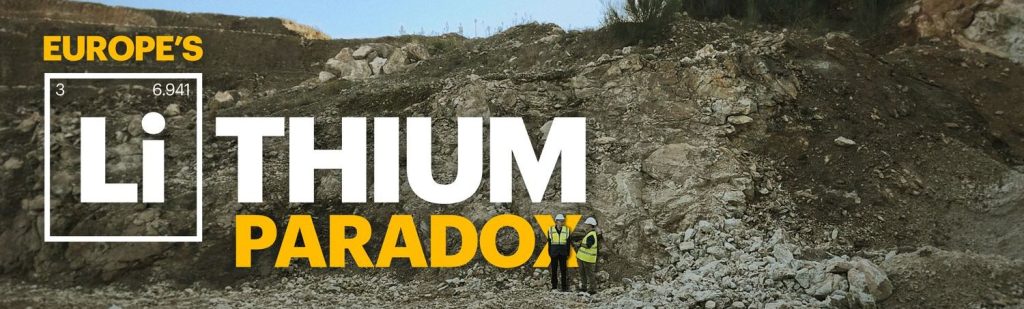
Europe’s Lithium Paradox premiering in Brussels
On 17 November, Europe’s Lithium Paradox held its final avant-première at Cinema Aventure (Brussels) — A full house! On 17 November “Europe’s Lithium Paradox” had its final avant-première event in

Press Release: Europe’s Lithium Paradox premieres on 17 November
On 17 November 2025, the documentary Europe’s Lithium Paradox will premiere globally on Journeyman Pictures’ YouTube channel, following a successful series of over ten avant-première screenings across Europe and Brazil.
Documentary:
Made in Europe: from mine to electric vehicle
The documentary “Made in Europe: from mine to electric vehicle” investigates the challenges faced by Europe as it attempts to set up its own, fully integrated, mine-to-EV value chain.
The film acts as a wake-up call to avoid that Europe’s decarbonisation strategy leads to a nightmarish de-industrialisation. Instead, the documentary shows that Europe’s transition to climate neutrality can go hand in hand with a cleantech-based re-industrialisation. Made-in-Europe.